Showing posts with label Time-Travel Challenge. Show all posts

Sunday, August 13, 2006

Time-Travel Challenge: Grunge To Rockabilly

Welcome to the third of my time-travel design challenges, in which I select a comic character who is mired in his or her decade's trends and imagine how they'd look if they had been created in another era. This time around I selected Grunge, whose name doesn't even have anything to do with his powers. He may as well have been called "Polka" or "Viennese Waltz." From his original "Kurt Cobain by way of Fantastic Sams" haircut to the overabundance of leather straps to that stupid winged skull tattoo on his chest, Grunge was a transparent attempt to lure readers by lumping together a bunch of fads.

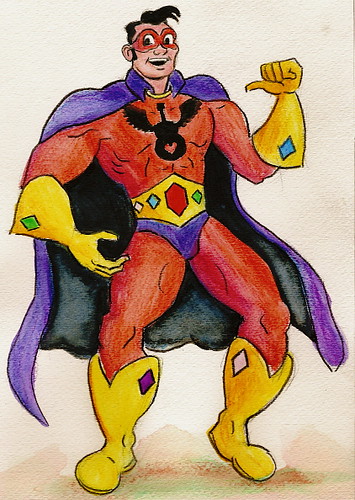
But comic book writers have pulled that crap for decades... as you'll see when I pluck Grunge from the depressing 90's and drop him down in the paranoid-yet-peppy late 50's. Behold... Rockabilly!
rockabillyhero

From "Sunshine Superman: Popular Music Trends In The American Comic Book" by Professor Nicolas Kim Coppola, published on Earth-4/4:

"In December of 1957, Elvis Presley received his draft notice. He entered the Army on March 24, 1958. That same week, in 'Blackhawk' #122, editor Jack Schiff introduced a pompadoured, super-powered guitar player named Percival Chang. His superhero codename: Rockabilly.

In that original story, Rockabilly is introduced in civilian garb as the American nephew of the book's repulsively stereotypical Asian character, 'Chop-Chop.' (The interaction of Rockabilly and Chop-Chop was visually jarring -- Rockabilly was depicted with a reasonable amount of realism, 'Archie Comics' eyeballs aside, while Chop-Chop was afflicted with a lemon-yellow hue, a massive overbite, and what can only be described as a 'Ringling Brothers Barnum & Bailey' penoir. ) In the midst of Rockabilly's visit to Blackhawk Island, the villainous Killer Shark attacks. After Rockabilly and Chop-Chop scurry for cover, the Blackhawks are mystified by the appearance of a mute 'Metal Man' who helps them to vanquish their foe. Near the end of the story, the Metal Man reverts to human form, revealing himself as Rockabilly. On the last page, he explains the origin of his powers. It turns out he had been practicing his guitar in a jalopy in the middle of a desert, not realizing until the last minute that it was the site of an A-bomb test. He found a foxhole but its sole inhabitant -- a spindly, bespectacle scientist -- panicked and pushed him back out of it just as the bomb exploded. Instead of killing him, the radiation gave him the ability to take on the property of any inanimate substance he touched. To this end, he had taken to carrying about various minerals in his pockets.

Rockabilly proved popular enough that in 1959 he was granted his own series, 'Romp With Rockabilly.' It was here he first donned his memorable, gem-bedecked belt, gloves, and boots. Alas, he wasn't so popular that he could survive the seeming demise of rock 'n' roll music that occurred prior to the advent of the Beatles, and a mere fourteen issues later, the book was cancelled.

Rockabilly's appearances were few and far between after that. In the 70's, Denny O'Neil used him for an issue of 'Black Canary/Black Orchid' (under the moniker 'Rocker') and Bob Rozakis included him as a member of 'Titans West' in two issues of the fading 'Teen Titans' comic. In the 80's, he played at Donna Troy's wedding in 'The New Teen Titans.' Also that decade, Phil Foglio starred him (under his original codename of 'Rockabilly') in a four-issue miniseries that revealed his third cousin to be the Wonder Woman villain, Egg-Fu. His last appearance -- and certainly his least illustrious one -- was in the background of a single panel in the "Kingdom Come" miniseries. There, literal-minded painter Alex Ross, never one to resist an obvious joke, depicted him in his old age as resembling the 70's Elvis: paunchy, bloated and stone-cold dead... on a toilet."


I liked the general idea of doing a 50's version of Grunge but Jeremy has barely any comics with him in them, none of which are "Gen13." So my fictional backstory for him has zip to do with his real-world ficitional backstory. Sorry.

Anyway, I gave him a nice wide belt for his fancy rocks, plus Western-style flared gloves and cowboy boots. Note the very 50's collared cape. And I translated that dopey tattoo into a logo combining wings, a guitar, and just for the hell of it, a heart. I think it works okay.

I'm not a big fan of trendy characters. I wonder how Grunge will fare in the coming years. At the very least, a name change is in order. I don't think even Dazzler would have lasted this long if her named had been "Disco Belle."

Monday, July 31, 2006

Time-Travel Challenge: Dazzler To Flapper

With the Time-Travel Challenge, I take a comic book character who typified the trends of a particular decade, and relocate them to another era... with appropriate alterations.

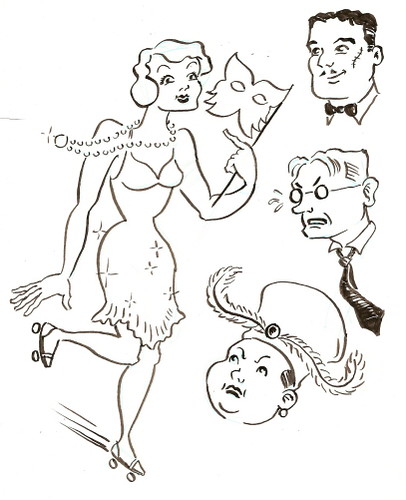
Chawunky suggested I do this with 70's disco queen Dazzler; Scipio suggested I move her to the 20's and call her Flapper. Well, they really didn't have proper comic books in the 20's. But they sure as hell had comic strips!

flapperstrip


From the book "Pioneering Women In Comic Strips" by Robbie Jerrison, published on Earth-36-24-36:

According to her friends and family, Claire Chrismont was a woman of few words. Despite -- or perhaps because of that -- her comic strip "Flapper" was a masterpiece of energy and pacing, with lean, snappy dialogue that only intruded upon the lovingly-delineated artwork when absolutely necessary.

The title character, Alison Blaire, was a shapely, roller-skating madcap with aspirations to a singing career. She was also fond of wearing spangles and sequins, which gave Chrismont the opportunity to decorate panels with dozens of "glitter lines" -- tiny starbursts which surrounded the character like a halo.

In 1926, the year of Flapper's debut, the newspapers were already filled with similar strips, such as Winnie Winkle the Breadwinner, Tillie the Toiler, Fritzi Ritz, and Mazie the Model. Where Chrismont's strip excelled, however, was in its supporting characters. While other comic strip flappers dealt with antagonists who were EITHER comic OR villainous, Alison Blaire was confronted on a daily basis by powerful oddballs who were a combination of both. And although they looked relatively normal, on an emotional level they gave the misfits of Dick Tracy's rogues gallery a run for their money.


Three of these were introduced in the strip's very first year, and they would be fixtures in "Flapper" for decades. There was Victor Von Doom, an eastern European playboy more in love with his own dueling scar than he would ever be with Alison. There was Bruce Banner, a meek, spindly radio show director with a non-verbal "split personality" that granted him the strength to overturn cars and bend lamp posts in half. And most memorably, there was the career-devouring gossip columnist Gail Atticus, whose inexplicable hatred for Alison was equalled only by her fondness for gigantic hats.

Beginning in the 30's, "Flapper" was handed off to a succession of female cartoonists, including Dee Falco, Fanny Dingeroth, and Midge Shooter, By 1958, its popularity had waned, and syndicate editors merged it with "Longshot," a dying strip about a three-fingered jockey. The new strip, Mex-Babies, found the two disparate characters running an orphanage in Tiajuana. It folded after three months.

Jeremy has the entire run of Dazzler in his collection. I'll pause here while you finish laughing. Done? Great. Anyhow, it made research a snap! As for the look, I just put her in a sparkly frock and changed the face paint to a mask-on-a-stick.

Whaddaya think?

Saturday, July 22, 2006

Time-Travel Challenge: Cable To The Mechano-Sarge

Yikes! I'm late again. Sorry guys, but I was exhausted last night (don't ask). I'll try to get a jump on next week's posts by working ahead this weekend. I really do want to get back to posting in the mornings.

Annnyway, here's my new challenge! My idea is to take a character emblematic of a certain era and redesign them as if they'd been created in some other decade. In this case, I took Mister 90's Excess himself, Cable, and recreated him as a Golden Age hero.

mechanosarge2

Excerpted from Don Thompson's essay, "OK, Axis, Here We Come!" in "All In Color For A Dime", published in 1970 on Triple-Reverse-Counter-Earth:

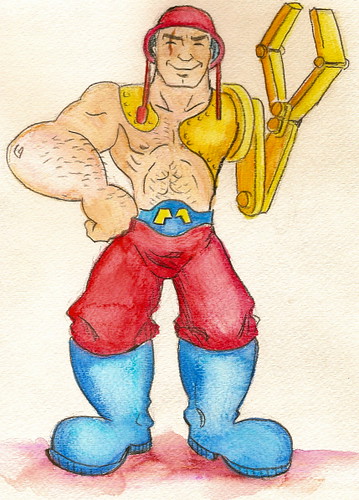
The oddest character published by Atlas during World War 2 was the Mechano-Sarge -- a time-traveling amputee with a crude robotic claw in place of his left arm. Born Nathan Summers, the Mechano-Sarge was an infant Londoner orphaned and critically injured in the Blitz. A mysterious, robed figure spirited the child off to Lemuria, an other-dimensional land "apart from the strife that wracks the mortal world." In Lemuria, the physical laws we know did not apply and the air was denser than water. The strange atmosphere worked to heal and toughen the lad's body into "a brawny mountain of a man with muscles like steel cables." His rescuer was a holy man, and along with the other mystics of Lemuria, he trained the orphaned boy to perfect his mind. This resulted in some ill-defined and arbitrary psychic powers that would change with the whims of whichever writer was assigned to the feature that month. Nathan Summers might have stayed in Lemuria forever, but he was a born scrapper with a wild, boisterous personality that left him ill-suited for a life of meditation. The Lemurian holy men outfitted the now-grown Nathan with a mechanical arm and sent him back home. Since time passed more quickly in Lemuria than it did in the mortal plane, he arrived only one month after he'd left it. Once there, he donned an impractically garish military uniform of his own design, christened himself the Mechano-Sarge, and plunged into the chaos of the second World war.

The Mechano-Sarge's adventures were brutal, gory affairs, typical of the comic book fare of that time. In one outing, his power of "Astral Vision" detected an Italian saboteur on the other side of a steel door, so he used his metal claw to punch right through it and crushed the "Italio-Nazi rat's" skull like a tin can. On other occasions, the Mechano-Sarge tore his foes in half, shoved live grenades down their throats, and twisted their broken bodies into the shapes of pretzels. In his most memorable outing, he mentally commanded Mount Fuji to erupt, destroying a munitions factory (and coincidentally killing countless non-combatants).

The Mechano-Sarge's feature disappeared from "Marvel Mystery Comics" exactly one year after the close of World War 2. In this final phase of his career, the London-born hero took up residence in the United States, and fought with markedly less violence and enthusiasm against racketeers and bank robbers. In his last two stories, he was reduced to a supporting character, while the focus was shifted to an obnoxious band of urchins calling themselves "Sarge's Battlin' Orphans."

For the Mechano-Sarge version of Cable, I made his "techno-organic" left arm an old-timey robot claw. I simplified the scarring around his right eye since that nonsense wouldn't have flown back in the 40's. And he's bare-chested because:
A. It shows off the robot arm and the metal plating on his chest better.
B. It worked for Uncle Sam.
C. I love to draw muscley shirtless guys. Hey, look! A nipple!

Although I strive for practicality in most cases, I made the costume's color scheme very bright, like a typical Golden Age hero's. The 40's simplification of the costume -- those artists sometimes had to draw a whole story in the space of a weekend -- is the reason why I didn't put laces on the boots. I wanted to put myself in the frame of mind of a penciler from that period.

Next week: more art! But I haven't decided exactly what yet.